

FAQs
Weekly Practice: Monday - Friday @ 2:50 PM on the Track, Saturday (mandatory for varsity athletes) at varying locations.
Meets: We have meets throughout MA and RI, with the majority against teams in the TVL Large, including Bellingham, Ashland, Norton, Holliston and Medway. More info on meets can be found on the MEET SCHEDULE tab.
Home Course: Our home course is at Hopkinton State Park
XC Basics
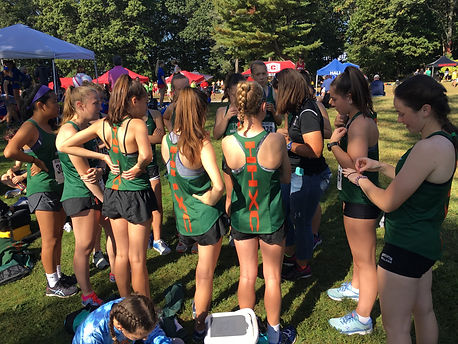
Team Makeup: A Cross Country team is made up of seven runners. The top five runners are the “scoring” members and the remaining two have the important job of displacing the scorers on opposing teams. Only the varsity level is limited to seven competitors in a race; other levels generally have unlimited entries.
Competition Levels: In New England, there are three levels in most cross country races. Each level competes in its own race and is scored separately. Most invitational races and league meets use the following levels: Varsity, Junior Varsity and Freshman.
Scoring: The first five runners from each team to cross the finish line receive the points that correspond to their place. The first place runner receives one point, the second place runner two, and so on. The team receiving the lowest score wins. The sixth and seventh runners on a team, although they don’t receive a score, can also be important, in that they can “displace” scoring runners from the other team.
Race Length: Most high school races are between 2 miles and five kilometers (3.1 miles) long. Occasionally a course will measure slightly shorter or longer. Some courses are limited by their geography and the distances are kept consistent from year to year.

Terminology
XC: Abbreviated form of Cross Country
Spaggers: Pre-race dinners for the whole team to get to know each other and relax a bit before the big race.
Harrier: The original name for a cross country runner. We use it to describe true cross country folk!
Invitational: A large race hosted by one or more schools. They provide better competition and larger fields of competitors.
PR: Personal Record (time)
PB: Personal Best (time). Used more commonly in Europe.
Aerobic: Running at a comfortable pace that keeps you in a heart-rate zone of 60-80% of your max.
Anaerobic: Short, intense running that does not rely on the body's ability to process oxygen.
Lactate Threshold: Running speed/heart rate at which lactate begins rapidly spiking in your blood stream, when your body switches from primarily aerobic energy production to anaerobic. Long story short, it makes continued effort more difficult.
VO2 Max: Short work bouts lasting from 3-5 minutes. Usually part of an interval workout.
Threshold: Refers to aerobic threshold training. Usually running for 15 to 30 minutes at a pace that is one minute slower per mile than your current mile PR.
Intervals: Segmented running one at varying intensities. Intervals can be any distance, but are most commonly between 200m and 2 miles.
Tempo: A sustained effort run that builds up your body's ability to run faster for longer periods of time. Typically done at a pace you can maintain for 40 minutes or more.
Recovery: Runs that allow athletes to rest after a hard effort. Theses runs are done by feel and do not have a prescribed pace, though generally you should be able to carry on a conversation.
Surge: A short burst of speed during a race. Used to change rhythm or break the competition.
Splits: Times associated with standard checkpoints in a race or workout. Ex: mile splits.
Kick: The sprint at the end of a race. Runners all have different abilities to kick.
Strides: Moderately fast runs lasting between 50-200m. The focus is on form during these runs.
